Finally, the British Medical Journal (BMJ) has released the results of the “polymeal” competition. You can find all recipes on bmj.com. From the winner recipe (submitted by Heather Haywood) I particularly liked the fondue. I am going to try the other ones as well (albeit with some minor modifications), and perhaps let you know the results.
During the past couple of months I have been doing many things, one of which was to try and implement DICOM network communication between my cephalometric software and a DICOM server. I must say that this is a very frustrating endeavour because the DICOM information manual (published by NEMA - National Electrical Manufacturers Association, medical.nema.org) is very difficult to read and understand. I got a lot of help from looking at the source code provided by the DCMTK software package and using the Conquest software as a testing bed. While I was doing all this, I was thinking about writing a do-it-yourself guide for all those who may need to do the same, but I am afraid that there is no free time. However, I am planning to release the source code, when it is done. Currently I am at the stage where the client communicates with the server and gets info about what images are available. The next step (which shouldn’t be that difficult) is to actually transfer the image from the server to the client.
Wednesday, June 22, 2005


Thursday, April 28, 2005
Baklava

Yesterday I made some baklava (for the first time). Now this should be considered heresy, because it contains no chocolate, but it came out excellent (even Katerina thought so), so I will give you the recipe. You need phylo for baklava (very thin), 250 gr pistachio nuts, 250 gr butter, 500 gr sugar and 300 gr water. I used a 30 x 35 cm baking pan. First melt the butter and use a brush to apply on the pan. Then add one phylo at a time. After spreading phylo sheet on the pan, brush liberally with butter. Continue for 8 to 9 layers. Then add the crumbled nuts, then add 8 to 9 more layers of phylo. Very important: carve the pieces (all the way down) with a sharp knife before baking. Cover with aluminium foil and bake for 30 minutes at 180 degrees (Celcius), then uncover and bake for 30 more minutes at 160, until golden. Meanwhile prepare the syrup by boiling the sugar and water for 5-10 minutes. When the baking is over, pour the syrup (while hot). I calculated total calories at around 6500, so that comes out at approximately 270 calories per piece (24 servings). I include picture of final product. Of course, you may also have seen chocolate baklava! This is something I should try some other day.
Monday, April 18, 2005
Back from Geneva and Vienna
Just returned from Geneva and Vienna. Weather was so-so, cloudy with a drizzle. In Geneva it was also rather cold. Why do the shops there close so early? Everything closes at 7 pm, and some shop owners close earlier than that, even though they have a sign with 7 pm on it at the door. I missed Zogg's the first day by about 10 minutes, but managed to be there on time the next day. I finally bought some chocolates from Zogg's (3 rue du Mont-Blanc) and from Gilles Desplanches (2 Confederation, Place Bel-Air). Prices are at around 95 Swiss francs per kilo, which is about 65 Euro. Both excellent, although I think that Gilles Desplanches may be slightly better. After returning home I tried to get into Zogg's web site (www.jpzogg.ch) but it does not seem to work. I will try again tomorrow.
In Vienna I had a Sacher Torte at the Sacher hotel. Nice, but not completely to my taste. The freshly squeezed orange juice was better. Next time I think I will try the Coupe Romanoff. Vienna is a very impressive city (the old town). Unfortunately I did not have time for anything more than a quick stroll yesterday evening. I would love to go to some of the museums, and especially the Leonardo Da Vinci exhibit.
In Vienna I had a Sacher Torte at the Sacher hotel. Nice, but not completely to my taste. The freshly squeezed orange juice was better. Next time I think I will try the Coupe Romanoff. Vienna is a very impressive city (the old town). Unfortunately I did not have time for anything more than a quick stroll yesterday evening. I would love to go to some of the museums, and especially the Leonardo Da Vinci exhibit.
Wednesday, April 13, 2005
Making Faces
Leaving for Geneva and Vienna tomorrow. Unfortunately, I doubt it if I will have much time to hunt for chocolates. I guess I will have to make do with what I find at the airport (isn't that sad?), mainly to cover orders from friends and family.
Have been reading a very nice book, "Making Faces" by Prag and Neave of British Museum Press. It describes how scientists reconstruct faces from skeletal remains. The book deals mainly with archaeology but discusses forensics also. The authors build up the face by adding layers of muscles and skin (using clay) on a duplicate of the skull. The whole method seems to involve a fair amount of artistic skill, but the authors claim that the result is reproducible because it is based on scientific principles (mainly data on the average thickness of soft tissues at various points on the face). A literature search in PubMed did not find many papers dealing with this issue. It seems that data are rather sparse. I wonder if we could get better predictive power concerning the relationship of hard and soft tissues if we factor morphometrics into the procedure. Is soft tissue thickness dependent on facial shape? How well can we predict soft tissue shape if we know the skeletal shape underneath? Nose size and shape could very well be correlated to skeletal shape (I know it is, because I have done some preliminary statistics, but is the correlation strong enough to be useful?).
Have been reading a very nice book, "Making Faces" by Prag and Neave of British Museum Press. It describes how scientists reconstruct faces from skeletal remains. The book deals mainly with archaeology but discusses forensics also. The authors build up the face by adding layers of muscles and skin (using clay) on a duplicate of the skull. The whole method seems to involve a fair amount of artistic skill, but the authors claim that the result is reproducible because it is based on scientific principles (mainly data on the average thickness of soft tissues at various points on the face). A literature search in PubMed did not find many papers dealing with this issue. It seems that data are rather sparse. I wonder if we could get better predictive power concerning the relationship of hard and soft tissues if we factor morphometrics into the procedure. Is soft tissue thickness dependent on facial shape? How well can we predict soft tissue shape if we know the skeletal shape underneath? Nose size and shape could very well be correlated to skeletal shape (I know it is, because I have done some preliminary statistics, but is the correlation strong enough to be useful?).
Sunday, March 06, 2005
SVD algorithm
Implemented IsoRegion leaping, as suggested by Fung and Heng (see posting of Feb 2, 2005). Speed increases significantly but is nowhere near interactive rates, for the size of volume and image that I target. A 700 x 650 image needs 6.3 secs to draw (compared to 14.4 without IsoRegion leaping). I am sure I could tweak some more speed out of this (e.g. by trying different brick sizes, optimizing some more) but the gain would probably be no more than 1 sec at the maximum. So the rest will have to come from reduced-quality rendering during interactive movement of the volume.
Meanwhile, during most of the past 2 weeks, I have been trying to implement a SVD (singular value decomposition) algorithm. I looked up the algorithm from Numerical Recipes in C, but the pdf files (c2-6.pdf) have a buggy old version. I finally figured that out (after many frustrated hours). The most recent version I could find on the net was the file svdcmp.cpp, which needed just two corrections, as mentioned in the Numerical Recipes bug reports. It is also written for zero-based arrays, in contrast to the one in the pdf file. I converted this to Delphi and it works perfectly (after correcting another two bugs that I introduced myself). Now I can use this to find least squares solutions. My aim is to calculate principal components of shape when some of the points are missing. This will allow me to find the most probable positions of the missing points, based on the other points and the shape variability of the sample.
And now for a different kind of recipe: chocolate prunes. I use prunes (dried) without the pits, place them for a few hours in brandy and red wine (half and half). Then I melt chocolate, pour some in small paper cups, immerse half of a prune in each cup and cover with some more chocolate. Very easy. Then leave in the fridge until set. 200 gr of chocolate make up approximately 30 small cups. Whatever brandy and wine is left over, you drink (but don't drive).
Meanwhile, during most of the past 2 weeks, I have been trying to implement a SVD (singular value decomposition) algorithm. I looked up the algorithm from Numerical Recipes in C, but the pdf files (c2-6.pdf) have a buggy old version. I finally figured that out (after many frustrated hours). The most recent version I could find on the net was the file svdcmp.cpp, which needed just two corrections, as mentioned in the Numerical Recipes bug reports. It is also written for zero-based arrays, in contrast to the one in the pdf file. I converted this to Delphi and it works perfectly (after correcting another two bugs that I introduced myself). Now I can use this to find least squares solutions. My aim is to calculate principal components of shape when some of the points are missing. This will allow me to find the most probable positions of the missing points, based on the other points and the shape variability of the sample.
And now for a different kind of recipe: chocolate prunes. I use prunes (dried) without the pits, place them for a few hours in brandy and red wine (half and half). Then I melt chocolate, pour some in small paper cups, immerse half of a prune in each cup and cover with some more chocolate. Very easy. Then leave in the fridge until set. 200 gr of chocolate make up approximately 30 small cups. Whatever brandy and wine is left over, you drink (but don't drive).
Friday, February 18, 2005
Optimization continues
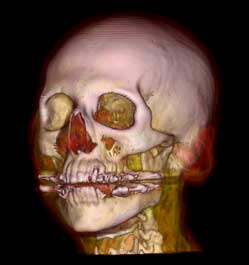
After a rather hectic week, at last Friday is here. Of course, Fridays are not so nice, because I work from 8 am to 8 pm, but after that I have the whole weekend in front of me for doing some more work! During the week I did not have much time to optimize the volume rendering algorithm much. I have prepared a nice picture (I hope you like it) of the Chapel Hill Dataset. It is shown here at half the actual size (when you click on it) and cropped. The actual image is 700 x 650 pixels and it takes about 9.5 secs to draw. This is way too much, so I will have to get really creative with the optimization tricks. The volume is 208 x 256 x 225 voxels in size (rather small). I have applied a 2D transfer function to show the bones and soft tissues.
I did some more web searching for Delphi optimization and found a really nice site (but with a few links broken). You can find it here. I applied the following changes, and the speed-up is significant:
1. Changed order of nested 'for' loops that loop over a three-dimensional array.
2. Changed FPU precision mode to: SetPrecisionMode(pmSingle);
3. Used multiplication instead of division. I multiply by the inverse, and this is much faster.
4. Turned off range checking and overflow checking (this is rather obvious, but do it after making sure the algorithm works OK): {$R-}{$Q-}
5. Changed sequence of instructions, to group together instructions that use the same variables.
6. Changed variables to smaller size (e.g. single instead of double, byte instead of word), where possible.
7. In-lined small procedures.
Changes that I thought would be beneficial but were not:
1. Changing the 'for' variable to anything else than integer slowed the loop down.
Changes I would like to make but have not figured out how, yet:
1. Substitute 'sqrt' with something faster (even if it is only approximate).
2. Same for 'trunc'.
3. Get rid of cache misses. This seems to be the major problem (I knew that, of course).
It seems that I will not be able to get interactive rates and keep the quality of the image at the same level. So I will probably have to resort to tricks, like drawing at reduced quality when rotating or translating the volume. I could not ask the user to get a faster machine, because I am using a Pentium 4 running at 3 GHz with 1 Gb of RAM. So, this is a fast machine already (for today, at least). Most of the profiling was done by using the QueryPerformanceCounter call. I know that this is not very accurate, but it gives a good estimate if you take the average of a few runs. I have tried VTune but there is a significant learning curve and I did not have much time to go into great depth. Looks promising though.
Sunday, February 13, 2005
Ray casting without errors
At last I have managed to complete the ray casting procedure in Delphi and it runs without errors. Now I need to make it much faster. I am using the data set from the Institute for Anthropology, Univeristy of Vienna, as one of my benchmarks. You can download it from here. The dataset is of a cranium without the mandible (too bad), at two resolutions. I am using the low resolution version (voxel size of 1 mm, total voxels: 218 x 218 x 142). In a window of approximately 470 x 470 pixels, it takes more than 6 seconds to draw. My target is to reduce this to less than a sec. I guess I could do it if I incorporate the IsoRegion idea. However, this particular dataset is rather noisy and the empty space around the cranium is not so empty. In contrast, the CT scan from the Chapel Hill Volume Rendering Test Dataset (get it here) is much 'smoother' and should benefit from IsoRegion leaping significantly.
Thursday, February 10, 2005
Chocolates from Geneva
Yesterday I got an unexpected gift, a small box of chocolates from Geneva. They are Du Rhone. The gesture was very kind and I am grateful. The chocolates were fine but I was not ecstatic. I remember that the best chocolates I have tasted were bought in Geneva on rue du Mont Blanc, two years ago. I will try to find some time and get some more this April, when I will be there. They were fantastic (but the price was also on the same level).
Meanwhile, the volume rendering procedure in Delphi is moving along. I have weeded out a few bugs and I think I can have it working in the next few days. Then it will be a matter of optimizing the code heavily. Those who are interested in volume rendering should definitely look into Stefan Bruckner's Master's thesis. I got some nice ideas from there, but I am not implementing it exactly as he proposes. I have kept the idea of subdividing the whole volume into bricks but I am not using his rather complex scheme of addressing. Instead, I have decided to duplicate some of the voxels (i.e. have the bricks slightly overlapping) so that calculation of gradients is easier (and hopefully faster). I am also thinking of implementing the idea of IsoRegion leaping, that I read about in a paper by Fung and Heng. A preliminary test showed that I should get a speed-up of a factor of 3 or 4, which is very significant.
Meanwhile, the volume rendering procedure in Delphi is moving along. I have weeded out a few bugs and I think I can have it working in the next few days. Then it will be a matter of optimizing the code heavily. Those who are interested in volume rendering should definitely look into Stefan Bruckner's Master's thesis. I got some nice ideas from there, but I am not implementing it exactly as he proposes. I have kept the idea of subdividing the whole volume into bricks but I am not using his rather complex scheme of addressing. Instead, I have decided to duplicate some of the voxels (i.e. have the bricks slightly overlapping) so that calculation of gradients is easier (and hopefully faster). I am also thinking of implementing the idea of IsoRegion leaping, that I read about in a paper by Fung and Heng. A preliminary test showed that I should get a speed-up of a factor of 3 or 4, which is very significant.
Wednesday, February 09, 2005
Delphi optimization
I am trying to code a volume renderer, to display computed tomography data. I have been struggling with it for some weeks now and have managed to produce a ray casting procedure, but it is still very slow (I will describe this in another posting later on). Searching the Internet I have come across some rather advanced (for me at least) optimization strategies for Delphi, which may interest some of you. Use Google to look for 'CodingForSpeedInDelphi.doc' by Dennis Christensen. It mentions VTune, a software by Intel that can be used to check for cache misses, cache thrashing and other esoteric stuff. Intel gives the software for a trial period of one month, but be prepared for a very long download time (size is about 200Mb!). I haven't tried it yet, but meantime I have applied some of the advice in the Christensen document (and in a ppt file, also found be Google: singlepe_optimize.ppt). By re-ordering some 'for' loops and substituting divisions by multiplications of the reciprocal, I have managed to shave off approximately 1 full second from the ray casting procedure (which amounts to 10% of the total). Now, if only I could get rid of those annoying Out of Range errors!
Tuesday, February 08, 2005
Welcome!
I start this blog with great reservations because I doubt it if I am going to keep it up for long. Anyway, I decided to experiment and see. This blog is for those who are interested in teeth and chocolate (not necessarily in that order, and not in the restricted sense of the words). I am into orthodontics, software development, teaching, and eating chocolates, besides other trivial pastimes. Postings here will contain info on any topic that comes to mind, in the hope of contributing to the ever expanding amount of useless knowledge that resides on the Internet.
Subscribe to:
Comments (Atom)